Having a crown, bridge, or dental implant does not automatically rule out clear aligners. It does mean the dentist needs to understand how your existing dental work fits into the changes you want to make.
The biggest distinction is what supports the restoration. A crown on a natural tooth may move with that tooth. A fixed bridge connects supporting structures and can limit independent tooth movement. An implant remains fixed during conventional orthodontic treatment.
At Cox Family Dentistry, we provide clear aligners in Sikeston, MO, with treatment planning that considers your teeth, restorations, bite, and oral health together. We explain your options clearly so you can make an informed decision.
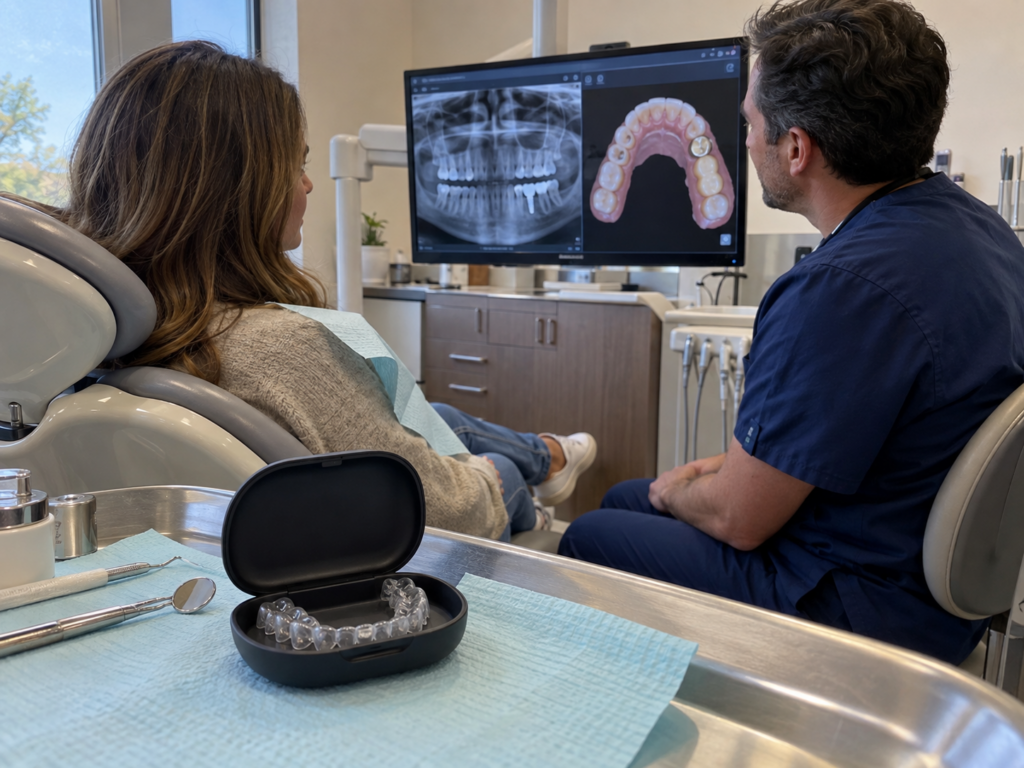
What Supports Your Dental Work?
People often use “crown” to describe both a cap over a natural tooth and the replacement tooth attached to an implant. They may look similar, but they behave differently during orthodontic treatment.
Natural teeth have a periodontal ligament between their roots and the surrounding bone. Orthodontic forces act through this supporting system as the tissues adapt and the teeth change position.
A dental implant joins directly with the jawbone. It does not have the same ligament and cannot be moved by conventional orthodontic forces.
Before discussing eligibility, the dentist identifies what each restoration is attached to. That information helps determine which teeth might move and which structures must be planned around.
| Existing dental work | Main treatment-planning consideration |
| Crown on a natural tooth | The underlying tooth may move if its health and support allow it. |
| Fixed tooth-supported bridge | Connected supporting teeth cannot move independently while the bridge remains intact. |
| Implant-supported crown | The implant’s position remains fixed during conventional orthodontic treatment. |
| Implant-supported bridge | The supporting implants also remain fixed; nearby natural teeth require separate evaluation. |
Clear Aligners With Crowns on Natural Teeth
A crown covers the visible part of a natural tooth without replacing its root. In appropriate circumstances, the crowned tooth can still be included in orthodontic treatment.
However, having a crown does not establish that the tooth is healthy enough for the planned movement. The dentist evaluates the underlying tooth, its supporting tissues, and the restoration itself.
Questions may include:
- Does the crown fit appropriately?
- Is there decay or damage that needs attention?
- Are the gums and supporting bone healthy?
- What movement is needed?
- How will the tooth meet neighboring and opposing teeth afterward?
The shape of the crown also matters because clear aligners fit around the visible surfaces of the teeth.
For example, a sound crown on a back tooth may present a different planning situation from a crown on a front tooth that needs substantial repositioning. Neither example establishes eligibility on its own.
Will the Crown Need to Be Replaced?
Not necessarily. Existing dental crowns are assessed individually rather than automatically replaced before aligner treatment.
A damaged or poorly fitting crown may need attention. In other cases, the dentist may consider whether its shape, appearance, or bite contacts should be reassessed after tooth movement.
Ask whether the proposed plan includes keeping, repairing, or replacing your crown, and why. The answer should reflect its condition and the intended changes.
Clear Aligners With Fixed Bridges
A traditional fixed bridge replaces a missing tooth using neighboring natural teeth for support. The replacement tooth and supporting crowns form a connected restoration.
That connection matters when teeth need to change position. The supporting teeth cannot be moved independently while an intact bridge holds them together.
This does not automatically prevent treatment elsewhere in the mouth. The key question is whether the planned movement involves the teeth supporting the bridge, nearby teeth, or a different area.
For example, aligning teeth away from a bridge may involve different constraints than changing the spacing between its supporting teeth. The dentist evaluates whether the intended result is compatible with the existing restoration.
If independent movement of the supporting teeth is needed, the plan may require changes to the bridge or a different treatment approach. Any proposed restoration changes should be explained before treatment begins.
What About an Implant-Supported Bridge?
Some dental bridges are supported by implants rather than natural teeth.
Those implants cannot be repositioned with conventional orthodontic forces. The plan must account for their existing locations and the bridge they support.
Knowing the type of bridge you have is therefore more useful than knowing only that you have “a bridge.”
Clear Aligners With Dental Implants
With dental implants, the implant post provides support for a replacement tooth. Once integrated with the bone, it does not respond to orthodontic forces like a natural tooth.
Natural teeth around an implant may still be candidates for movement. However, their final positions must be planned in relation to the implant restoration.
This can affect available space, neighboring tooth contacts, and how the teeth meet when you bite.
A crown attached to an implant cannot be moved like a crown covering a natural tooth. Changes to the visible implant restoration, if appropriate, are different from moving the implant post itself.
The dentist also assesses the health of the tissues around the implant. Its presence alone does not establish that the mouth is ready for aligner treatment.
What If You Need Aligners and New Dental Work?
When restorative treatment and tooth alignment are both being considered, discuss them together before starting.
The sequence depends on the condition of your teeth and the intended result. Decay, infection, or a damaged restoration may need attention before movement begins.
At the same time, planned tooth movement may change the space available for a future crown, bridge, or implant restoration. The dentist may need to coordinate the final restoration with the planned tooth positions.
This does not mean all crowns or bridges should be postponed until after alignment. A tooth that needs protection should not be left untreated simply to follow a general sequence.
If you are considering an implant that has not yet been placed, discuss alignment goals early. Planning both treatments together can help account for the implant’s intended position.
What Does the Evaluation Consider?
An evaluation looks beyond the number of restorations you have.
The dentist considers your bite, which teeth need to move, the health of your gums and supporting tissues, and the condition of existing dental work. Your dental history and treatment goals also matter.
Examination findings and appropriate records help determine whether clear aligners can address the proposed changes. Existing restorations are one consideration, but the type and complexity of the movement are also important.
Some cases may require coordination with an orthodontist or another specialist. The aim is to recommend an appropriate approach rather than assume one treatment will suit every situation.
At Cox Family Dentistry, Compassion. Connection. Confidence. means taking time to explain the findings, listen to your concerns, and discuss your choices without pressure.
Questions to Ask a Dentist in Sikeston About Clear Aligners
If you are searching for the “best dentist near me” to discuss clear aligners with existing dental work, ask how the practice evaluates your restorations and coordinates treatment. A useful consultation should explain which teeth can move, what may need attention first, and the alternatives available to you.
Consider asking:
- Which teeth are expected to move?
- Will my existing restorations stay in place?
- Does any dental work need repair or replacement?
- How does my implant’s fixed position affect the result?
- What alternatives should I consider?
- Will another specialist be involved?
Also ask how restoration changes would be coordinated. Repairing or replacing a crown or bridge may change how an appliance fits.
For broader guidance on evaluating a local practice, read our guide to choosing a dentist in Sikeston..
Frequently Asked Questions
Can a tooth with a crown move with clear aligners?
A crown on a natural tooth may move with the underlying tooth if its condition and supporting tissues permit the planned treatment. An implant-supported crown is different because the implant cannot be moved by conventional orthodontic forces.
Does a bridge have to be removed before aligner treatment?
Not automatically. The answer depends on the bridge’s design and whether its supporting teeth need to move. The dentist assesses whether the existing restoration can remain compatible with the proposed treatment.
Can clear aligners move an implant into a better position?
No. Conventional orthodontic treatment cannot reposition an integrated dental implant. Treatment may involve moving suitable natural teeth around it, while planning around the implant’s existing position.
Should I replace an old crown before starting?
Age alone does not determine whether a crown needs replacement. Its fit, condition, underlying tooth, and relationship to the planned movement guide that decision. Ask how any necessary restoration work fits into the overall sequence.
Do several crowns or implants make clear aligners impossible?
Not necessarily. The number of restorations matters less than their support, location, condition, and relationship to the intended movement. A clinical evaluation is needed to determine whether aligners are appropriate.
Discuss Your Options at Cox Family Dentistry
You deserve a clear explanation of how your dental work affects treatment. We can review your oral health, discuss your goals, and help you understand the recommended next steps.
Contact Cox Family Dentistry to discuss clear aligners in Sikeston, MO, and how your existing crowns, bridges, or implants may influence your treatment options.